
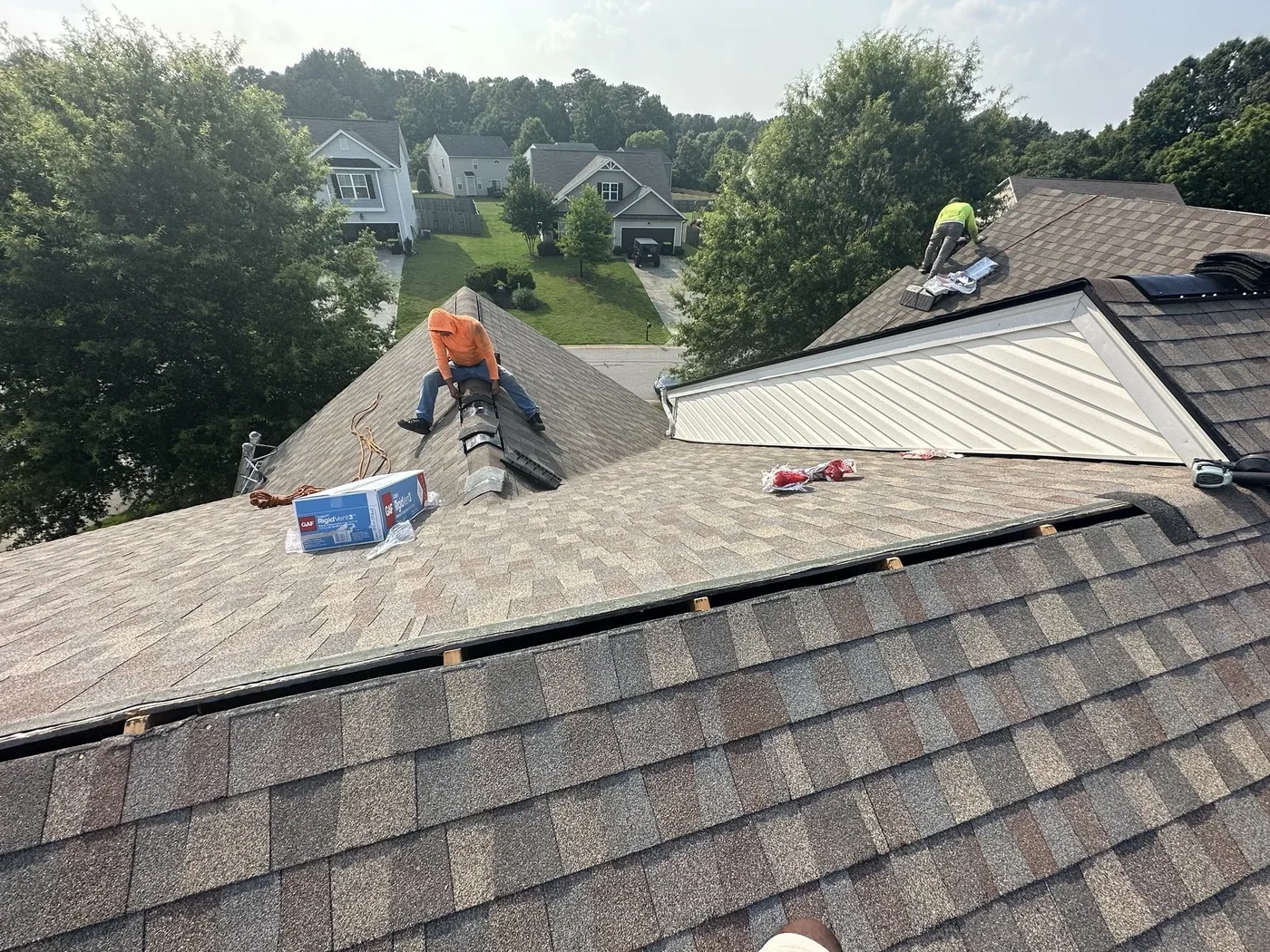
The rubber boot around a vent pipe
A collar of rubber around a pipe, cooked by the sun for fifteen years until it cracks. It is the most common leak on a Triangle roof and one of the cheapest to fix, which is a rare piece of good news.
Find it in the attic, not on the ceiling. Contain it with a bucket and a tarp if the weather has passed. Then get the actual entry point repaired, because the stain on your ceiling is almost never under the hole in your roof.
Here is the part that catches everyone. Water lands on the roof, finds a nail hole or a lifted flashing, then runs along the top of a rafter until something stops it. That something is usually a light fitting, a joint in the drywall, or the exact middle of your living room ceiling, which is where it finally drips and where you will stand pointing at it.
So the hole is uphill of the stain, often by several feet. [I once watched a homeowner set four buckets under a ceiling while the leak sat above the garage.]
We are GAF Certified, family owned, and we find leaks for a living across Raleigh and the Triangle. This page is the honest version of what to do, including the parts where the answer is to stop and call someone.
In this order, and none of these involve a ladder.
Bucket, towel, and something under the bucket, because the floor did not do anything to deserve this. Move anything electrical out from under it.
If the drywall is sagging with a pocket of water in it, put a small hole at the low point with a screwdriver and drain it into the bucket. It feels wrong. It is much better than the whole sheet coming down at three in the morning.
The ceiling, the wall, the floor, anything ruined. Insurers pay on evidence rather than description, and you cannot photograph it after you have cleaned up.
A wet roof is the single most common way this goes from an expensive repair to an ambulance. Ours wait for the weather too.
A covered roof tonight, a proper repair when it is dry. Our emergency roof repair page covers it.
Wait for the rain to stop, then go into the attic with a torch. You are looking for a dark stain on the underside of the decking, a rusty nail, damp insulation, or daylight. Daylight is the easy day.
When you find the wet spot, measure. Take a tape from something that exists on both sides of the roof, a chimney, a vent stack, a gable end, and write the number down. That measurement is what lets a roofer walk straight to the right square foot instead of guessing across forty of them.
If the attic is finished or the ceiling is vaulted, this step is not available to you. That is the point where a free inspection saves you an afternoon.

Shingles get blamed for most leaks. Shingles cause a minority of them.
A collar of rubber around a pipe, cooked by the sun for fifteen years until it cracks. It is the most common leak on a Triangle roof and one of the cheapest to fix, which is a rare piece of good news.
Thin metal pieces woven into the shingles up a wall or a dormer. When one lifts or someone caulks over the problem instead of replacing it, water goes behind the siding and travels a long way before it shows.
The single most reliable leak on an older house. Counter flashing pulls out of the mortar joint, someone seals it with roofing cement, the cement cracks the following summer, and here we are again.
Where two roof planes meet, the water is concentrated and so is the debris. Pine needles pack in, hold water against the shingles, and the valley stops draining and starts soaking.
Every nail that backs out is a hole. Every bead of caulk from a previous owner is a hole with a lid on it. We find more leaks caused by past repairs than by weather.
Freezing rain refreezes at the roof edge and backs water up under the first courses of shingle. If your leak only happens in winter, this is probably it, and ice and water shield is the fix.
Raleigh averages 46 inches of rain a year, and a fair share of it arrives in summer storms that dump for twenty minutes. A roof that sheds a normal shower can still back up at a clogged valley when the rain is horizontal.
Then there is impact. Wake County logged 69 hail events between 2020 and 2025, and the county has taken 79 mph gusts from a hurricane that had already crossed half the state. Hail cracks the mat under the granules and wind creases tabs, and neither looks like anything from the driveway.
And pines. Needles fill the valleys and the gutters year-round rather than once in the fall, which is why a Triangle roof needs its valleys cleared more often than the roof it was designed by.
Three of these are things a roofer does. One is a thing a tube of caulk does, badly.
A cracked boot gets a new boot. Lifted step flashing gets new step flashing woven back into the courses. Sealant over either one is a repair with an expiry date, usually the next hot summer.
If the leak has been going a while, the plywood under it is soft. Shingling over soft decking is how a repair fails in a year. It comes out, new decking goes in, then the shingles.
Shingles fade. A patch on a ten year old roof will sit slightly brighter, and on a front elevation that matters to some people. We show you before we start rather than after.
Three leaks in three places on a twenty year old roof is not three repairs, it is a roof telling you something. We will say so, and quote the replacement next to the repair so you can see both.
Our repairs start at $625, and the final figure depends on what has failed, how accessible it is, and whether the decking underneath needs replacing. A cracked vent boot on a walkable roof is the cheap end. Chimney flashing on a steep third story is not.
The full breakdown by cause, what insurance covers and what it does not, is on our roof leak repair cost guide. If the leak came from a storm, our insurance claims page covers how we document it and meet the adjuster with you.
The inspection that tells you which conversation you are in is free, and it stays free whether or not you hire us. That is the actual next step, and our roof repair page explains what happens after it.
A tarp over the damage, yes, if the pitch is walkable and the weather has passed. Anything past that is usually a bad trade: the repair is cheap, the ladder is not, and most DIY leak fixes seal the stain rather than the hole.
Start in the attic with a torch on a dry day and look for the stain on the decking, then measure from a fixed point like the chimney or a vent. Water travels along rafters, so the wet ceiling is almost never under the hole.
Contain it first: a bucket, and a small hole punched in a bulging ceiling to let the water out in one place rather than bring the plaster down. Photograph everything. Do not get on a wet roof.
Not long. A leak that shows inside has usually been wet above the ceiling for weeks, and decking that stays damp loses strength and grows mould. The cost of waiting is the decking, not the shingle.
Usually yes if a storm caused it, usually no if age or neglect did. That is why the photographs and the dated report matter more than the argument.
And more. Don’t see your city? Call (984) 224-7182.
We get on the roof, photograph what is actually there, and hand you a written report with a price. No charge, and no obligation to book the work with us. If the roof has years left in it, that is what the report will say.
Whether you need a roof replacement, roof repair, or annual inspection, we’ve got you covered.