Ordered by what we fit most, not by price. Exhaust and intake are two halves of one system, and the intake half is the one that is usually missing.
Ridge vent, best exhaust on almost any roof with a ridge
$300 to $650 installed Net free area: 12.5 to 18 sq in per linear foot.
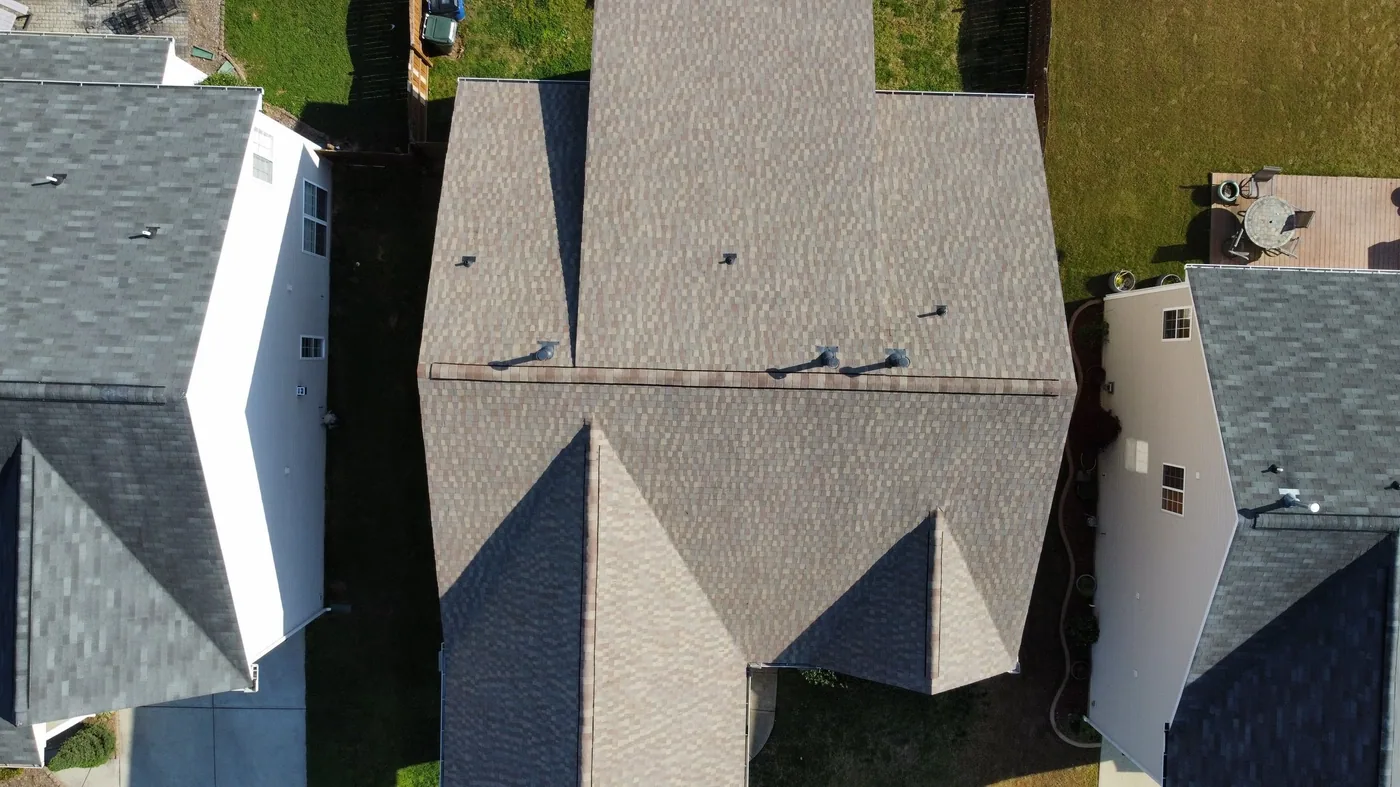
A continuous vent along the peak, under a cap of shingles or a metal cover. It exhausts along the whole ridge rather than at a few points, it has no moving parts and nothing to fail, and it is nearly invisible from the ground. GAF publishes 18 square inches of net free area per linear foot for Cobra Rigid Vent 3 and 12.5 for the rolled RidgeRunner, so the product choice changes the math.
The catch. It needs matching soffit intake to work. A ridge vent over painted-shut soffits pulls its air from the house below instead, which is worse than no vent at all.
Soffit vent, the half of the system that is usually missing
$200 to $500 for a house Net free area: printed on the vent.
Intake, under the eaves. Every exhaust vent on the roof is only as good as the intake feeding it, and intake is what gets blocked: by paint, by insulation shoved into the eaves, or by soffit panels that were never perforated in the first place. This is the first thing we check and the most common thing we find wrong.
The catch. Not a roof job on its own. If there is no soffit to vent, the alternative is an edge or fascia intake vent, which costs more and has to be detailed properly.
Box or static vent, best where the roof has little or no usable ridge
around $500 per unit installed Net free area: published per unit, commonly 50 to 60 sq in.
Individual low-profile vents set near the top of the slope. On a hip roof with almost no ridge, or a roof chopped into short runs by dormers and valleys, these are how you get exhaust area without a ridge to put it on.
The catch. Each one covers a small area, so matching one ridge run takes several, and every one is another hole in the roof. More penetrations means more places to flash and more places to leak.
Gable vent, cheapest vent to fit, and the easiest to get wrong
$75 to $250 per unit Net free area: printed on the vent.
A louvered vent in the gable wall. It needs no roof penetration at all, which makes it the cheapest and least risky thing to install, and on a simple gable attic with cross ventilation it moves real air.
The catch. Mixed with a ridge vent it short-circuits the system: the ridge pulls its air from the nearest gable vent instead of up from the soffits, and the far end of the attic stops moving air at all. Pick one strategy.
Turbine vent, moves the most air on a windy day
$75 to $300 per unit Net free area: depends on wind, not published as static NFA.
A spinning cowl that uses wind to draw air out, and when the wind blows it shifts considerably more air than a static vent of the same size. They are cheap and they have been on Carolina roofs for fifty years.
The catch. No wind, no airflow, and Triangle summers have plenty of still hot days. They are also the noisiest thing on this list once the bearings go, and bearings go.
Powered or solar attic fan, best for an attic that cannot get enough passive area
$300 to $1,200 installed Net free area: rated in CFM, not net free area.
A thermostat-controlled fan, mains or solar powered. Where the roof geometry simply will not give you the passive area the attic needs, a fan is the honest fix, and a solar unit costs nothing to run.
The catch. A fan with inadequate intake pulls conditioned air out of the house through ceiling gaps, which raises the power bill it was sold to lower. Fix the intake first and quite often you do not need the fan.
Not sure your attic is ventilating?
It is the first thing we check on a free inspection, and blocked soffits are the most common thing we find.
The mistake
Never mix a ridge vent with gable vents
Air takes the easiest route. A ridge vent is supposed to pull air up from the soffits at the bottom of the roof, across the underside of the deck, and out at the peak. That is what moves heat and moisture out of an attic.
Put an open gable vent a few feet from the ridge and the ridge vent takes its air from there instead, because it is closer and easier. The bottom of the roof stops moving air entirely, and the far end of the attic stops ventilating.
The fix is to pick one strategy. Either ridge and soffit, which is what we fit on almost every roof, or gable-to-gable cross ventilation on a simple attic. Blocking the gable vents when a ridge vent goes on is a ten minute job during a reroof.
Work out how much area the attic needs with our ventilation calculator, then divide by the net free area printed on whatever vent you are considering.
Questions
Roof ventilation questions
What is the best type of roof vent?
A ridge vent with matching soffit intake, on any roof that has enough ridge to carry it. It exhausts along the whole peak, there is nothing mechanical to fail, and it is invisible from the ground. Box vents are the right answer where there is no usable ridge.
How many roof vents do I need?
It is an area calculation, not a count. Code wants net free ventilating area of 1/150 of the attic floor, or 1/300 where the ventilation is balanced and there is a vapor retarder. Our ventilation calculator turns attic size into the square inches you need.
Can you mix ridge vents and gable vents?
You should not. The ridge vent takes the easiest air available, which is the gable vent a few feet away rather than the soffits at the bottom of the roof. The result is an attic that ventilates a small area well and the rest not at all.
Are powered attic fans worth it?
Only where the roof cannot provide enough passive area, and only with intake to match. A fan with starved intake pulls air-conditioned air up out of the house through ceiling gaps, which is how a product sold to cut cooling costs ends up raising them.
How much does roof ventilation cost?
A ridge vent runs $300 to $650 installed, box vents around $500 a unit, gable vents $75 to $250, and powered or solar fans $300 to $1,200. On a reroof, adding ridge venting is a small line because the ridge is already open.
Why does attic ventilation matter for my roof?
Asphalt ages by losing granules and it loses them faster on a hot deck. An attic that runs hot all summer gives you the bottom of the published lifespan rather than the top. Ventilation is the cheapest line on a roofing quote and the one most often trimmed.
Do I need vents if I have spray foam on the roof deck?
No, and you must not have them. Foam on the underside of the deck makes the attic part of the conditioned space, and that assembly is designed to be unvented. Leaving the vents in traps moisture against the deck.
Keep reading
Related guides and calculators
Ventilation, insulation and roof lifespan are the same conversation.
Including the attic, which is where ventilation problems show first.
Free on-site inspection
Get your attic ventilation checked, free
We get on the roof, photograph what is actually there, and hand you a written report with a price. No charge, and no obligation to book the work with us. If the roof has years left in it, that is what the report will say.