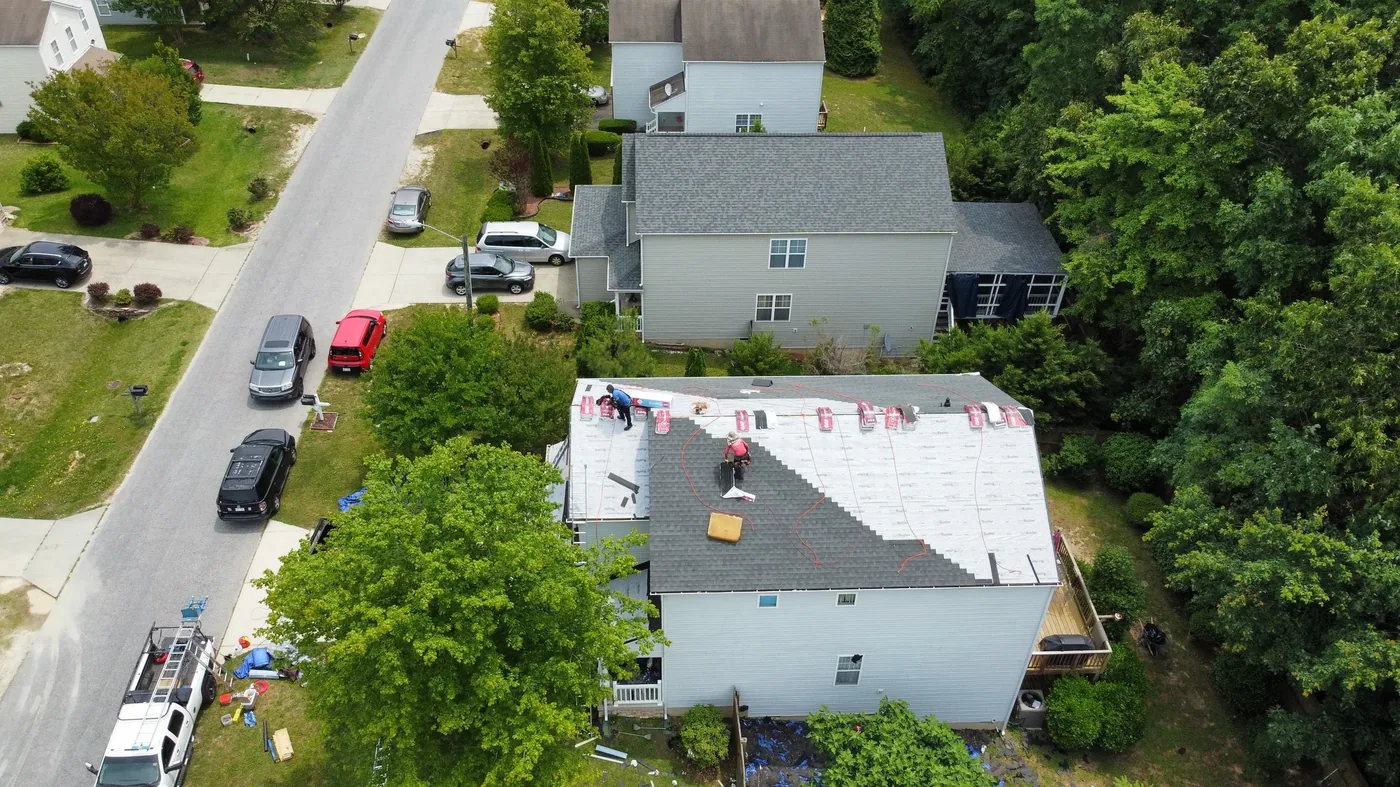
1. The unsolicited knock after a storm, the one NCDOI names first
NCDOI's guidance opens by telling homeowners to be suspicious of contractors who show up unsolicited, often after storms, and to politely decline and do their own research. Not every door knocker is a fraud. The point is that the knock itself carries no information about whether they are any good.
The catch. A crew that is in town for the season has no reason to still be here when a workmanship warranty is called on in year three.
2. The free inspection that always finds damage, watch who goes up
A free inspection is a normal way for a roofer to win work, including ours. It turns into a problem when the person inspecting is the person who gets paid only if damage is found. NCDOI warns that fake inspectors may claim to find damage and push for quick repairs, and says that if you suspect damage you should contact your insurer first, or a roofer you picked yourself.
The catch. Damage that appears only in photographs you did not watch being taken is worth a second opinion.
3. Pressure to sign on the spot, including the thing that is not a contract
The form that gets signed at the door is often not presented as a contract at all. It may be called an authorization to inspect, a work authorization or a contingency agreement, and it can still commit you. NCDOI's advice is to resist high-pressure tactics and read all contracts.
The catch. Any document that has to be signed today, before you have a second quote, is a document to take away and read.
4. The assignment of benefits, the signature with the longest tail
An assignment of benefits hands the contractor your right to deal with your insurer and be paid directly. NCDOI says never to sign one unless you fully understand the legal implications. It is not automatically a scam, but it moves you out of the conversation about your own claim.
The catch. Once signed, disputes about scope and payment happen between the contractor and the insurer, and you may not be in the room.
5. The large upfront deposit, there is a published norm here
NCDOI puts a standard deposit at 10 to 20 percent, with most of the money due after the work is completed to your satisfaction, and flags full payment or large deposits before any work begins as a red flag. That gives you an actual number to measure a request against rather than a feeling.
The catch. A deposit far above that range, in cash, on a job that has not been scheduled, is the shape the disappearance takes.
6. Offering to cover your deductible, not a discount
A roofer who offers to absorb, waive or eat your deductible is proposing to bill your insurer for money nobody paid. The cost is usually recovered by inflating the claim or thinning the work, and the policyholder's name is on the claim.
The catch. The homeowner is a party to that arrangement, not a bystander to it.
7. Being asked to pull the permit yourself, a quiet one
Permits are normally pulled by the contractor. Being asked to pull it in your own name is worth a direct question about why, because it moves responsibility for the work onto the homeowner and it can indicate the contractor cannot pull one.
The catch. It is the least dramatic item on this list and the most informative.