
Soffit and fascia repair in Raleigh
What we replace, how we match the profile, and what it looks like after.
One faces the street and carries your gutters. The other faces the ground and lets the roof breathe. Here is how to tell them apart, how to tell when they have gone, and what the published figures actually say.
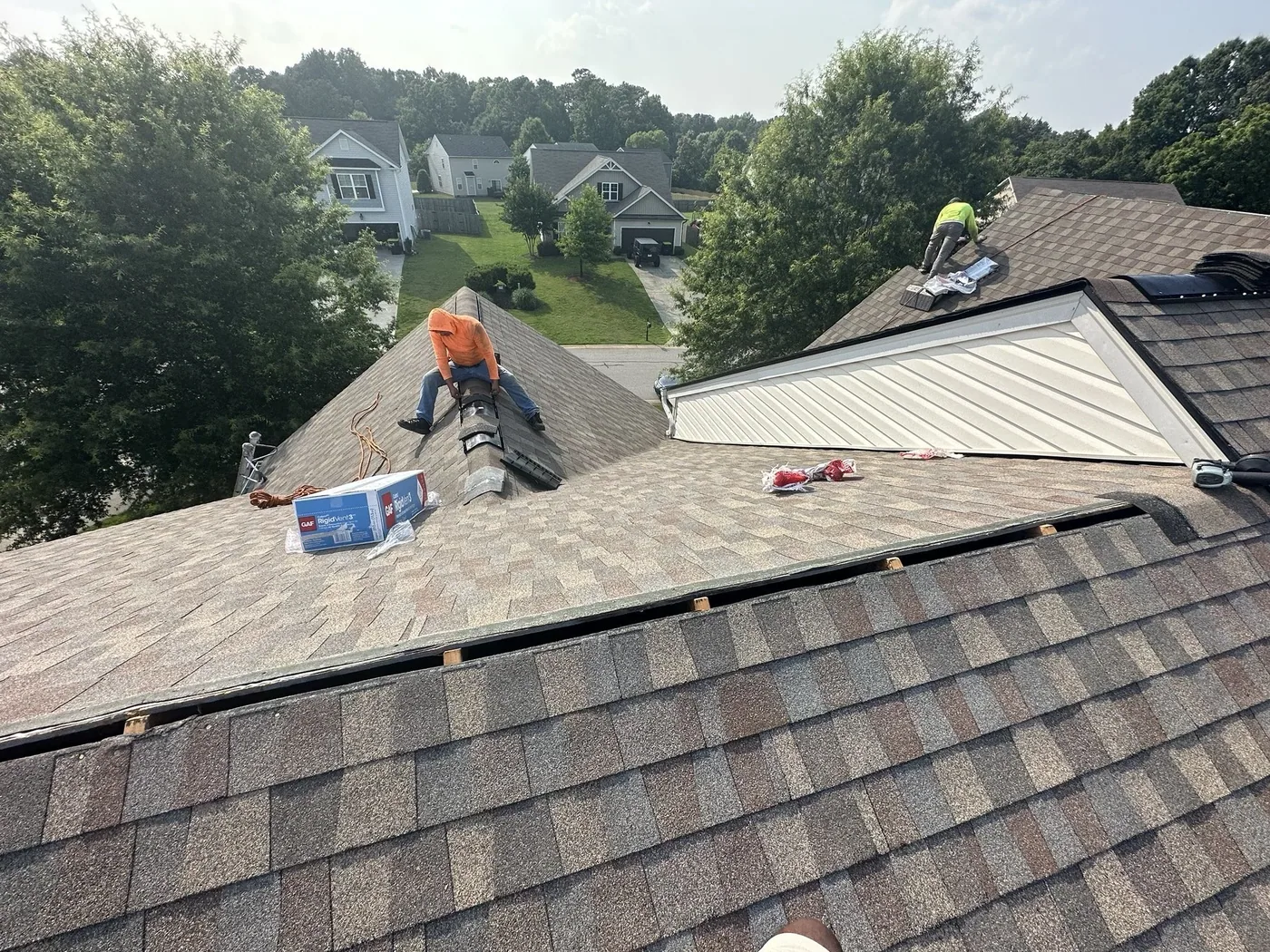
Most people have these the wrong way round, and the names are no help at all.
Fascia is the board running along the edge of your roof, facing the street. Your gutters are screwed to it. It holds things up and keeps water out of the roof edge, which is why every house has it.
Soffit is the panel underneath the overhang, facing the ground. It is vented, so air can get into the attic and move through. It carries no load, and not every house has it.
The quick test: if you can see it standing on the pavement, it is fascia. If you have to stand under the eave and look up, it is soffit.
One caveat on everything below. Both publishers have Raleigh specific pages for gutter cleaning and junk removal, and neither has one for this work. The figures here are national. We are not going to relabel a national average as a local price.
Four things separate them, and only one is about looks.
| Fascia | Soffit | |
|---|---|---|
| Where | Along the roof edge, facing the street | Under the overhang, facing the ground |
| Job | Carries the gutters, seals the roof edge | Vents the attic so air can move |
| Visible | Yes, from the street | Only from directly underneath |
| Required | Yes, on every house | No, though most houses benefit |
Figures from Angi's soffit versus fascia explainer, last updated 9 July 2026.
They are almost always replaced together, and not for upsell reasons. The soffit tucks in behind the fascia, so the fascia has to come off to reach the soffit whichever one has failed. Doing them in two visits means paying twice for the same removal and the same ladder time.
Cheapest material first. The order is computed from the published ranges.
| Material | Per linear foot | Notes |
|---|---|---|
| Wood | $1 to $3 | The default on most Raleigh houses and the one that rots. Five to 15 years before it needs attention. |
| Fiber cement | $1 to $5 | Only This Old House publishes a price for this. No fiber cement soffit figure exists anywhere we could read. |
| Composite | $2 to $8 | Holds paint better than wood and does not feed insects. |
| PVC | $3 to $7 | Will not rot at all, which is the entire argument for it. |
| Vinyl | $5 to $9 | Usually chosen to match vinyl soffit rather than on its merits. |
| Aluminum | $8 to $20 | The dearest, and the one that lasts 10 to 20 years or more. |
Material costs from Angi (8 October 2026) and This Old House. Ordered by midpoint.
Those are material rates. Fitted, Angi puts fascia replacement at $7 to $22 per linear foot, averaging $14.60, and This Old House at $7 to $40. The figure both agree on exactly is labor at $6 to $20 per foot, and that is the more useful anchor: on this job access costs more than the board does. Hard to reach eaves add a published 7% to 15%.
| Length | Total fitted cost |
|---|---|
| 300 ft | $2,100 to $6,600 |
| 200 ft | $1,400 to $4,400 |
| 150 ft | $1,050 to $3,300 |
| 100 ft | $700 to $2,200 |
| 50 ft | $350 to $1,100 |
Figures from Angi, last updated 8 October 2026. Most houses have 100 to 200 linear feet of roof edge.
Same ordering rule, cheapest first.
| Material | Per linear foot | Notes |
|---|---|---|
| Wood | $1 to $3 | Needs venting cut into it, and that is where the rot starts. |
| Composite | $1 to $8 | A wide band because the quality range is wide. |
| PVC | $3 to $7 | Comes pre-vented. |
| Vinyl | $5 to $9 | The most common replacement here. Pre-vented and it does not need painting. |
| Aluminum | $8 to $20 | Along with steel, the material most often specified for soffit rather than fascia. |
Figures from This Old House, last updated 2026. Ordered by midpoint. No fiber cement soffit price is published by either source, so none appears here.
Vinyl is the common choice here and the best documented. Angi puts a vinyl soffit job at $6.50 to $14 per linear foot fitted, averaging $10.20, for a national project average of $2,550. Most houses carry roughly 250 feet of eave. Eaves deeper than 16 inches need framing, which adds $200 to $600, and rot found once the old panel is off runs $100 for minor damage to $1,000 where it is severe.
Vinyl figures from Angi (14 October 2026). Combined soffit and fascia repair is published at $600 to $6,000 by Angi (17 March 2026).
Worth reading before you treat any single number as the market rate.
Angi prices a 200 foot fascia job at $1,400 to $4,400. This Old House prices a 250 foot job at $1,750 to $10,000. The top ends are more than twice apart for work that differs by a quarter in length.
It gets worse inside a single page. This Old House gives soffit replacement as $17 per foot and $4,250 for a one story house in its body text, then $10 per foot and $2,500 in its own FAQ. Angi puts combined soffit and fascia repair at $600 to $6,000 in one place and $300 to $7,200 in another on the same page, and quotes roofers at $75 to $120 an hour on one page and $40 to $80 on another.
We are telling you this rather than picking the tidiest figure because the only honest read is that this work is priced on access and on what the boards look like once they are off, and no published average predicts that well. Use the $6 to $20 per foot labor band, which both publishers agree on, and get it measured.
Four signs, in the order you are likely to notice them.
Paint that bubbles or peels along the roof edge. Moisture behind the board pushing out. It is usually the first thing visible from the ground.
Splits, holes or dark patches. Mold and moss on the board means it has been staying wet.
The screwdriver test. Push one into a suspect board. If it sinks in, the wood has gone and filler will not hold. This is the test both publishers recommend and it takes a minute.
Gutters starting to twist or pull away. Gutters should run straight. When they do not, the problem is usually the fascia they are fixed to rather than the gutter itself, which is why rehanging them without replacing the board does not last.
Pests in the attic, or sagging soffit panels, point the same way. Wood lasts five to 15 years here; aluminum and PVC run 10 to 20 or more. If yours are original and wooden on a house of any age, they are at the end of that window.
The one lever that genuinely saves money on this job.
All three publishers say the same thing, which is rare enough in this research to be worth noting: bundling fascia with gutters, drip edge or a roof replacement saves on labor, because the access and the tear-off are shared instead of being paid for twice. Drip edge runs about $1 to $2 per foot fitted when it is already open.
It is also the only sensible moment. The gutters have to come off to replace fascia, so if they are near the end of their life you are paying to take them down either way. The work itself takes one to two days for a typical house.
We are GAF Certified, and fascia, soffit and gutters are the three things we most often end up doing together with a roof replacement, because that is when all of it is accessible at once.
The questions that come up on site.
Fascia is the board running along the edge of the roof, facing the street, and your gutters are screwed to it. Soffit is the panel underneath the overhang, facing the ground, and it is vented so air can get into the attic. Fascia holds things up and keeps water out. Soffit lets the roof breathe. If you can see it from the pavement it is fascia, and if you have to stand under the eave and look up it is soffit.
Angi puts it at $7 to $22 per linear foot fitted, averaging $14.60, with a national project average of $2,500. This Old House publishes $7 to $40 per foot for the same work. The one figure both agree on exactly is labor at $6 to $20 per foot, which is why access drives the price more than the board does. These are national numbers. Neither publisher has a Raleigh page for this work.
Only if the soffit is genuinely sound, and usually it is not. The soffit tucks in behind the fascia, so the fascia has to come off to reach it either way. Doing one and then the other later means paying twice for the same removal and the same ladder work.
Look for splits, holes and peeling or bubbling paint along the roof edge, mold or moss on the boards, and sections that sag. Then do the screwdriver test: push one into a suspect board, and if it sinks in, the wood has gone and patching will not hold. Gutters that have started to twist or pull away are usually a fascia problem rather than a gutter problem.
Yes, if the timing works. All three publishers say the same thing: bundling fascia with gutters, drip edge or a roof replacement saves on labor, because the access and the tear-off are shared rather than paid for twice. It is also the only sensible moment to replace fascia, since the gutters are already off.
One to two days for a typical house, per Angi. Rot found once the boards are off can extend that, and repairing pre-existing rot behind the soffit is published separately at $100 for minor damage up to $1,000 where it is severe.
The boards, the gutters hung on them, and the roof above.
What we replace, how we match the profile, and what it looks like after.
The $117 visit that stops water getting into these boards.
Seamless runs hung on sound fascia, sized for Carolina rainfall.
When the boards come off anyway, and the labor is already paid for.
Material lifespans, and the ventilation that decides most of it.
We get on the roof, photograph what is actually there, and hand you a written report with a price. No charge, and no obligation to book the work with us. If the roof has years left in it, that is what the report will say.
Whether you need a roof replacement, roof repair, or annual inspection, we’ve got you covered.