
Deck stair calculator
Free deck stair calculator. Enter the deck height and get the number of steps, riser height, total run, stringer length and count, using DCA 6 code limits.
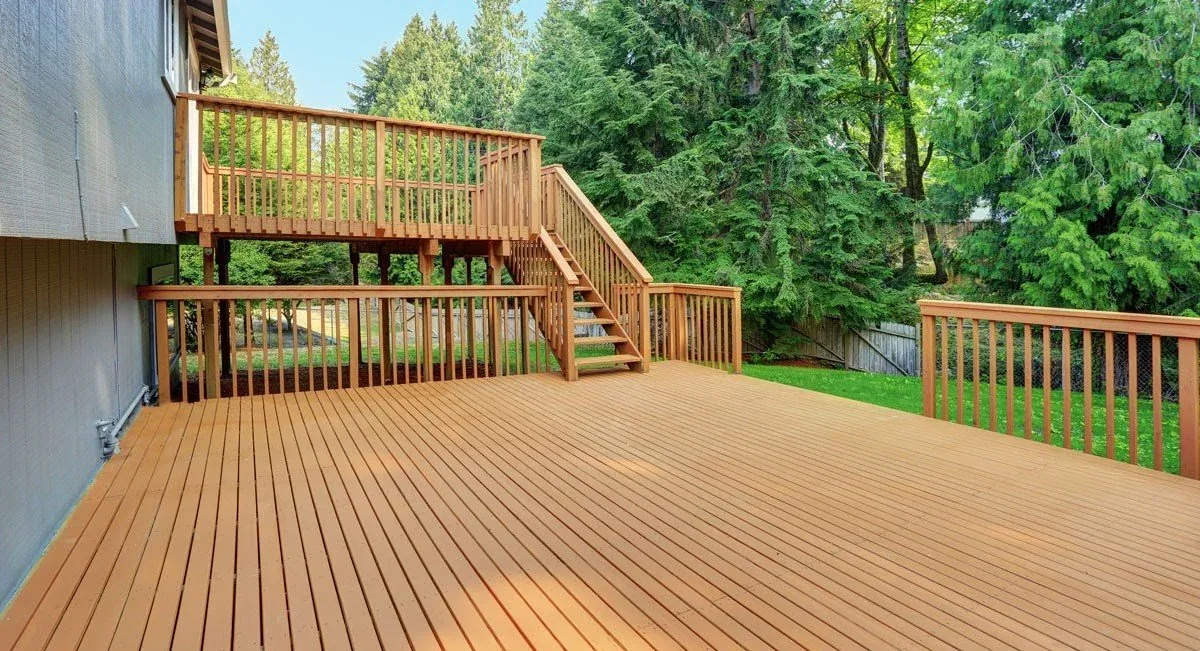
Deck size, railing and coats in. Gallons out, with the railing counted properly and a lower coverage rate for weathered boards.
Roof pitch & slopeSquares & shinglesReplacement costRoof lifeDeck costGutter costRoof ventilationIce & water shieldRoof trussesAttic insulationDeck boardsDeck stainPaintJunk removal
Railing counted at 3 sq ft per linear foot, which allows for both faces, the cap and the balusters.
Get the deck quotedMost deck stains quote 250 to 350 square feet a gallon, and that figure assumes smooth timber that has been sealed before. Published coverage data puts rough sawn or weathered boards nearer 150 to 200, and bare new cedar or pine lower still, because dry open grain drinks the first coat.
This calculator uses 300 for smooth, 200 for rough or weathered and 150 for thirsty bare timber, then rounds up to whole gallons. Running out halfway across a deck leaves a lap mark you cannot sand out.
A 40 foot railing with balusters is roughly 120 square feet of surface once you count both faces, the cap rail and every spindle. Skip it and you underbuy by a third on a small deck.
A second coat uses less than the first because the timber is already sealed, but only on a semi-transparent or solid stain. Penetrating oils are applied to refusal, meaning you stop when the wood stops taking it, so a second coat on top of a saturated board just sits there sticky.
Replacing boards before you stain? The deck board calculator works out the count, and our deck building and repair page covers the work itself. Related: The best deck stains.
Add the deck area to the railing counted at about three square feet per linear foot, then divide by the coverage rate. Three hundred square feet a gallon on smooth boards, nearer 200 on rough or weathered timber.
Weathering opens the grain, so the surface absorbs two to three times what a sealed board takes. Bare new cedar and pine are porous for the same reason and can drop to 150 square feet a gallon.
Three square feet per linear foot is a reasonable allowance for a standard 36 inch railing with balusters. That covers both faces, the top of the cap rail and the spindles, which together are more surface than people expect.
Semi-transparent and solid stains usually look better with two, and the second coat uses roughly two thirds of the first. Penetrating oils are applied until the wood stops absorbing, so a second coat often is not needed at all.
Not always. Pressure treated timber often arrives wet and needs weeks to dry before it will take stain, and the test is to sprinkle water on it. If it beads rather than soaking in, it is not ready.
It slows the water that causes rot, which helps. What it does not fix is a wet detail underneath, like a ledger flashed badly or a post sat in standing water, and those are what actually take decks down.
Free deck stair calculator. Enter the deck height and get the number of steps, riser height, total run, stringer length and count, using DCA 6 code limits.
Free deck footing calculator. Beam and joist spans in, footing diameter and square size out, using DCA 6 loads (40 psf live, 10 psf dead) and soil bearing.
We get on the roof, photograph what is actually there, and hand you a written report with a price. No charge, and no obligation to book the work with us. If the roof has years left in it, that is what the report will say.
Whether you need a roof replacement, roof repair, or annual inspection, we’ve got you covered.